
From Paper to Performance: Building a 2026 Plan That Works

This is Part 4 in Oomph’s 2026 Planning Series.
Part 1 helped you take stock of what’s in place — your marketing and BD systems, tools, and results. Read the article here.
Part 2 showed how to set priorities — deciding what to keep, pause, or change. Read the article here.
Part 3 turned those priorities into a working budget — linking dollars and hours to the initiatives that matter most. Read the article here.
Now comes the final step: Putting It All Together. This is where you move from plan to program — turning all the work you’ve done into a coordinated calendar with timing, accountability, and a clear 90-day start plan. The goal: a strategy that doesn’t just exist on paper but actually runs.
1 | FROM PLANNING TO EXECUTION
By this point, you’ve done the hard part. You know where your marketing and BD systems stand, you’ve clarified what matters most next year, and you’ve assigned a realistic budget. Now it’s time to make it operational.
The focus here isn’t redefining brand or market strategy — that’s work for next year. The 2026 framework is about building a foundation that works: systems that run smoothly, tactics that align with goals, and teams that deliver consistently.
“Putting it all together” means turning strategy into motion — identifying what happens when, who’s responsible, and how progress will be tracked. This is where marketing and BD stop being side tasks and start operating like managed programs — supporting the business as actively as project delivery or finance.
2 | BUILD A ONE-PAGE OPERATIONAL PLAN
Before diving into the calendar, condense everything into a single page that gives leadership and marketing/BD teams a shared reference point. Think of it as your operational blueprint for 2026 — not a glossy strategic plan, but a clear, check-in-five-minutes summary.

Include:
2026 Priorities: the 3–5 initiatives you’ll advance this year (proposal overhaul, CRM rollout, pursuit tracking, client-outreach series).
Systems to Strengthen: website, templates, CRM, photo library, analytics tools.
Key BD Tactics: pursuits, client engagement, events, partnerships, sector activities.
Resource Snapshot: budget — both dollars and internal hours.
Accountable Leads + Checkpoints: who owns each initiative and when progress is reviewed.
This one-page view anchors the year. It keeps leadership aligned and helps marketing and BD teams focus on the right work, not just the urgent work.
3 | TRANSLATE PRIORITIES INTO A WORKING CALENDAR
Once the one-page plan is clear, map those priorities across the year. The calendar is what turns aspiration into workflow.
Sequence by Quarter: Breaking the year into four phases balances ambition with reality:
Q1 — Foundation & Setup: Focus on infrastructure and preparation: updating the website or project library, organizing templates, running training, finalizing the content plan, and kicking off any new systems like a CRM or analytics dashboard. Q1 is your “construction phase” — setting up everything that will make the rest of the year easier.
Q2 — Visibility & Outreach: Once systems are in place, shift attention outward. Publish new content, refresh proposals with current material, attend client conferences, and re-activate events and sponsorships. This is typically the most active quarter for marketing and BD visibility.
Q3 — Relationship Building: Mid-year is when most firms get busy with project delivery — but it’s also when client relationships deepen. Use this quarter for targeted follow-ups, client visits, and outreach that keeps the pipeline healthy. Q3 is where your visibility turns into opportunity.
Q4 — Review & Renewal: Finish strong by reviewing what worked, preparing awards and submissions, refreshing project data, and setting up the groundwork for next year’s planning. Q4 isn’t just reflection — it’s preparation for the next cycle.
Each quarter should include short deliverable lists and check-ins built into the firm’s regular schedule. Predictable cadence builds consistency — and consistency builds results.
Build in Realistic Timing
AEC teams live by project schedules, but marketing rarely gets the same discipline.
Respect workload patterns: proposal peaks, vacation seasons, and client deadlines.
Spacing initiatives evenly across the year prevents burnout and keeps everything moving through busy pursuit periods. A strong plan feels steady, not frantic.
4 | SET CADENCE AND ACCOUNTABILITY
A plan that isn’t reviewed regularly drifts. Cadence — the rhythm of meetings and updates — keeps it alive.
Monthly Marketing Check-Ins: Short 30-minute sessions to review current initiatives, confirm upcoming deadlines, and flag resource constraints. These aren’t reporting meetings — they’re problem-solving meetings.
Quarterly Leadership Reviews: Align progress on marketing and BD initiatives with financial performance and firmwide priorities. This is the moment to adjust allocations, redirect effort, and reset expectations.
Mid-Year Re-Alignment: Every July, hold a 60-minute “mini-planning” session. Confirm what’s working, what’s done, and what needs to shift before Q4. The best marketing plans breathe; they don’t stay frozen all year.
Accountability matters as much as cadence. Each funded initiative should have one accountable lead and a clear definition of “done”.
When leadership and marketing/BD share cadence, the conversation shifts from “What’s marketing doing?” to “How are we pacing against plan?”
5 | ALIGN BUDGET, HOURS, AND TIMING

The budget defines what’s funded. The calendar defines when it happens. Execution depends on capacity — the hours available to deliver it.
Convert each initiative into hours per month:
CRM rollout → 40 hours in Q1
Content plan → 10 hours/month ongoing
Client events → 30 hours across Q2–Q3
This reveals whether you have bandwidth — and when to bring in support. If the hours exceed capacity, you can scale back, spread work, or outsource. Making those decisions early prevents burnout by May. Showing time alongside cost helps leadership see marketing as capacity management, not just spending.
6 | KEEP THE PLAN ADAPTIVE
Even the best plan will need adjustments. AEC markets move fast: projects shift, public-sector funding opens or closes, clients change direction. A plan that can’t bend will break.
Quarterly Adjustments:
At each review, ask three questions:
Still relevant?
On track with hours and spend?
Still worth the effort?
Pause or redirect anything that’s stalled or off-target.
Four Tools for Flexibility:
Strategic Reserve: keep 5–10 % of your total marketing and BD budget unassigned. It’s there for opportunities that arise mid-year — a client event, sponsorship, or partnership that wasn’t predictable in January.
Stop-and-Start Rule: stop one low-value initiative for every new one you start. This maintains balance and protects bandwidth.
Scenario Planning: build “base” and “stretch” versions of your plan. If work slows, you know where to trim; if it accelerates, you know what to add.
Rolling Forecast: update spending and hours monthly so leadership can see whether the firm is pacing ahead or behind.
Adaptability doesn’t mean changing direction constantly — it means responding intelligently without losing focus.
7 | THE 90-DAY START PROGRAM
Most annual plans stall because they’re too big to start. The solution is to break the first quarter into a focused 90-day start program — a compact, realistic set of actions that prove the plan is working.
Choose 3–5 Actions
Select the initiatives that will build the foundation for everything else — for example:
Finalize your 2026 proposal templates.
Launch the new CRM or pursuit-tracking system.
Update your project photography and content library.
Refresh your newsletter or LinkedIn rhythm.
Host one targeted client event.
These are visible wins that build confidence and momentum.
Assign Ownership + Hours
Each action needs one accountable lead and clear time commitment.
Publish the list internally so everyone knows what’s moving.
Run 30-Day Checkpoints
Every 30 days, review what’s been completed, what’s stuck, and what’s next. Keep meetings brief and forward-looking. By the end of March, you’ll have tangible proof that the plan isn’t theoretical — it’s operational.
The 90-day start program creates rhythm and momentum, making the rest of the year easier to sustain.
8 | Common Pitfalls and Fixes
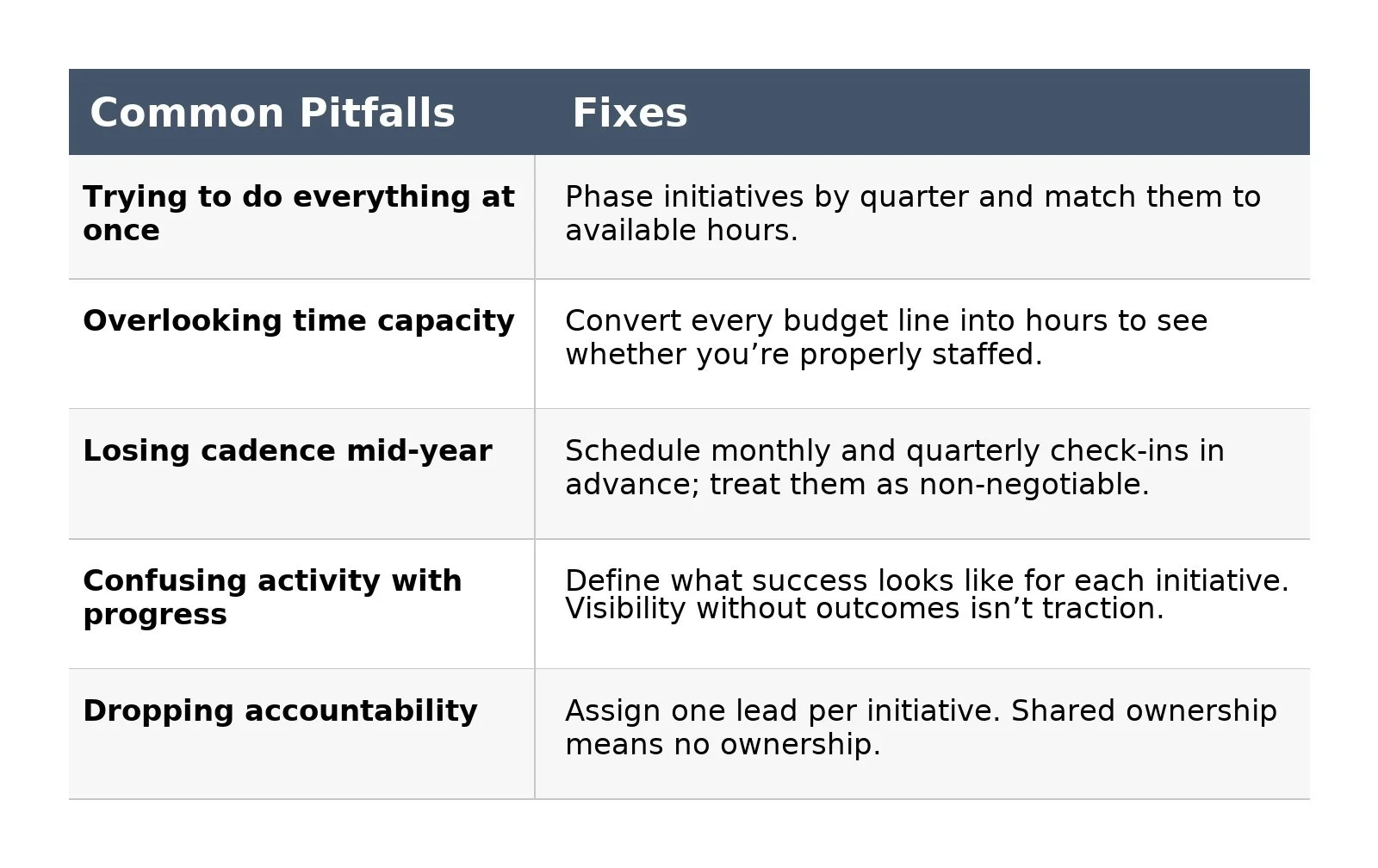
Even strong plans can derail. Watch for the traps above. One lead per initiative — always. Most firms don’t fail because they plan poorly. They fail because they stop checking.
9 | WHAT THIS MEANS FOR YOUR FIRM
If you’ve followed the 2026 Planning Series, you now have a complete operational framework:
Review what exists and where the gaps are.
Focus on what truly matters.
Budget realistically — in dollars and hours.
Plan the year ahead with visibility, measurement, and manageability.
That’s the foundation. It’s not yet brand strategy or repositioning — that will come next year, when the systems and habits are in place. For now, the goal is competence and consistency: a marketing and BD program that runs smoothly, delivers value, and supports the firm’s business objectives every quarter.
When you reach this point, marketing stops being reactive. It becomes a managed process — one that gives leadership visibility, gives teams structure, and gives the firm control over its pipeline and profile.
NEXT STEPS
👉 Use your funded priorities to build your 2026 operational calendar and 90-day start plan.
Oomph’s upcoming planning tools will combine all four stages — Review, Focus, Budget, Plan — so your firm can run the same process internally next year.
End of Series — 2026 Planning for Design Firms
Coming 2026: Oomph’s 2027 Planning Series will move to the next level — brand positioning, differentiation, and market strategy — building on the foundation you’ve just put in place.
