
What Happened When We Hired Ourselves

Almost two years ago, we did something we spend a lot of our time helping other firms do: we developed a content program for ourselves.
In a sense, we hired ourselves, and it has been a fascinating exercise. It's like an architecture firm designing its own office. You know the work. You do it for other people. But becoming your own client gives you an entirely different view of the process.
For us, that meant putting our own thinking into practice and living with the results. Over the past two years, we've published articles, interviews, industry commentary and research. We've experimented with formats, topics and platforms. We've watched what people read, what they respond to, what starts conversations and what quietly disappears. We've stopped doing some things, doubled down on others, and changed our approach as we've learned.
And we've learned a lot.
STRATEGY IS JUST THE BEGINNING
We spend a lot of our time developing strategy for clients, so perhaps the first lesson shouldn't have surprised us.
A good strategy matters enormously. You need to know who you're trying to reach, what you want to talk about, what you have to say that's useful, and how all of that connects to where the business is going. But the strategy is just the beginning.
A strategy can give you the framework. It can identify the themes you want to own and the subjects you need to be talking about. But then you have to turn those broad themes into a steady stream of individual stories, each with a clear idea, a strong angle and something genuinely worth saying. And you have to keep doing it. Month after month after month.
That's where the plan on paper becomes a publishing program. And it's where we learned just how demanding the execution really is. Once the strategy exists, the real challenge begins: sustaining it.
EXECUTION IS NOT FOR THE FAINT OF HEART
We have always known how much work communications programs require. After all, this is work we do every day for our clients. Becoming our own client, however, gave us a particularly close view of what it takes to sustain every aspect of a content program over time.
For starters, there is the editorial planning: identifying the subjects, developing the ideas, finding the right angles, deciding what form each story should take and building a production schedule.
Then there is the actual production. Researching. Interviewing. Developing the questions. Working out the argument. Writing. Editing. More editing. Developing graphic concepts. Finding and preparing images. Producing newsletters. Posting to the website. Then adapting each piece for LinkedIn, Instagram, Facebook and X, all in different lengths and formats, with different graphics, tone and style for different audiences. Scheduling and posting it all. And then beginning again.
Day after day, week after week, month after month.
It is a monumental amount of work.

And doing it for a while doesn't make it any easier. A growing library certainly helps. In a pinch, you can return to earlier ideas, update material, connect stories and repurpose strong content rather than continually starting from zero. But there are only so many subjects that are central to any firm's expertise. If business development is important to us, we can't write the same article about selling five times. That takes real work to keep from just repeating yourself.
That requires creativity and ingenuity, but also commitment, capacity and resources. Because the real challenge isn't producing one excellent article, one interview or one newsletter. It's being able to produce good work consistently, and to keep doing it for long enough for the investment to pay off.
That, more than anything, is what makes a serious content program so demanding: sustaining the quality, the ideas and the output over time.
PUBLISHING SHARPENS YOUR THINKING
Thought leadership is ultimately about putting your firm's expertise, approach and point of view into words.
Much of what we know is normally communicated in pieces. It comes out in a client meeting, in advice given during a project, in a presentation, in a conversation about a particular problem. Everyone understands the point, the work moves forward, and you move on.
Writing about that expertise is different. You have to take all those pieces and put them together in one place. You have to flesh out the thinking, examine the assumptions behind it and work through every part of the argument. What exactly do we believe? Why do we believe it? How does one idea connect to the next? What have years of doing this taught us? And how do we explain all of that logically, clearly and in enough detail that it is genuinely useful to someone who isn't sitting in the room with us?
Publishing didn't give us a point of view. We already had one. It forced us to articulate that point of view clearly and develop it more fully. In a sense, it has allowed us to take decades of accumulated knowledge, experience and judgement and begin putting some order around it: distilling it, clarifying it and making explicit things that, after years of doing the work, had become almost instinctive.
Beyond this, sustained publishing creates another challenge and teaches another discipline. You don't get to explain what you know once and call it a day.
Our business, like that of our clients, is built around a relatively defined group of subjects. In our case, those subjects include strategy, positioning, business development, growth, communications and marketing. These are our areas of expertise, and naturally they are what we showcase in our thought leadership. But if you're publishing month after month after month, you have to keep coming back to those same areas and finding fresh ways into them.
That means looking at a familiar subject from another angle. Asking a different question. Going deeper into one part of it. Connecting it to something changing in the market. Taking something you've discussed before and examining what it means under different circumstances. The expertise may be the same, but the story can't be.
And that forces you to look at your own knowledge in new and fresh ways.

When you're writing about business development for the tenth time, you have to look harder, ask different questions and find something you haven't said quite that way before. Sustained publishing doesn't just require expertise. It requires you to keep finding new perspectives on the expertise you already have.
There is another lesson in this that has become particularly important to the work we do with architecture, engineering and other design firms: the knowledge behind the work is every bit as valuable as the work itself.
In our case, we learned this partly out of necessity. Much of what Oomph does is confidential. We develop positioning, competitive strategies, go-to-market strategies and business development programs for clients. We can't turn around afterwards and publish a case study explaining exactly what we did for all of their competitors and the rest of the market to see.
So, beyond fairly basic descriptions of the scope of our work, we had to build our content around the knowledge behind it: what we have learned, how we approach problems, what we believe, what we see changing in the market, where firms struggle and what decades of doing this work have taught us.
Architecture and engineering firms are sitting on enormous reservoirs of this kind of knowledge.
You see it when a technical expert speaks at an industry conference, and you see it in proposals, where firms have to demonstrate clearly what they know, how they work and why their experience matters. Yet when they return to their day-to-day marketing, much of that expertise disappears. The focus shifts back to generic marketing language and showcasing projects, often with little explanation of the knowledge and thinking behind them.
Of course, showcasing projects is critically important. But the design itself is only one part of the expertise a client is buying, and it's only one part of a very long and complex process. There is also the firm's approach to project management, technical delivery, documentation, approvals, sustainability, collaboration and understanding the client's business. There are the specialized skills its people have developed, the processes it has refined and the lessons accumulated across dozens of projects.
That is an extraordinary amount of knowledge to build a content program around.
Doing this for ourselves continuously has made us much more adept at finding that knowledge, drawing it out and turning highly specialized expertise into an ongoing stream of content that is useful, accessible and interesting to the people a firm wants to reach. The challenge isn't finding one story. It's learning how to keep finding stories in the expertise you already have, week after week, month after month.
After everything I've just said about the amount of work involved, the obvious question is:
Is it worth it? Absolutely. But it takes time.
The commonly cited rule of thumb is that a serious content marketing program can take 12 to 18 months to begin producing meaningful results. Our experience was remarkably close to that. For much of the first year, we were building an audience, a library of content, visibility, consistency and a substantial body of work.
Then we began to see the cumulative effects much more clearly. Our LinkedIn following and engagement grew. Traffic to our website increased significantly. At industry events, people I had never met would tell me they followed us or had been reading our articles. Clients referred to stories they had read and asked whether we could do something similar for them. Prospects came into conversations with a much clearer understanding of what Oomph actually does.

The library itself also became increasingly valuable. An interview could lead to another article. Something raised in a client conversation could expose a larger industry issue worth exploring. Earlier stories could be revisited when something changed in the market, and content could be adapted for presentations, proposals and business development conversations. The individual pieces were no longer standing alone; they were becoming an interconnected body of work.
In other words, the program was doing exactly what thought leadership is supposed to do: building awareness, demonstrating expertise, strengthening our reputation and making what we do much more visible and understandable.
So far, so good. But then something happened that we hadn't anticipated. And, strangely enough, it came out of a decision we had made near the very beginning of the program.
When we first started publishing, I asked several friends and collaborators in marketing to look at what we were doing and tell me what they thought. Most of them essentially said the same thing: the content was very good. But it was much too long.
Our articles and interviews are typically between 2,000 and 3,000 words. We were told they should be closer to 750, with more keywords and content structured more deliberately around SEO. One friend actually took one of our articles and reworked it to show me what a properly search-optimized version looked like.
I read it and decided we weren't going to publish that kind of content. Technically, the advice may have made perfect sense. But the story had disappeared.
More importantly, I thought about the people we interview. These are extremely knowledgeable people who give us hours of their time, from the initial meeting and preparation through the interview itself and then reviewing the finished piece. They share years, and sometimes decades, of experience with us. Reducing those conversations to 750 words organized around search terms didn't simply feel at odds with why we were doing the interviews. It felt disrespectful.
I wanted the people we interviewed to read the finished piece and be proud of it. I wanted them to feel that we had represented what they said accurately and done justice to what they had shared with us. And I wanted anyone reading the interview to come away having genuinely learned something.
The same standard applied to everything else we published. If we were going to put our name on something, it had to be something we would find interesting to read and that we would be proud to publish.
So we ignored the advice and kept producing long-form interviews and articles, generally between 2,000 and 3,000 words, written in a natural voice. We followed the story rather than the keywords and concentrated on the quality of the ideas, information and expertise.
We had no idea, when we made that decision, that the way people searched for information was about to change.
Then, last fall, we began seeing referrals to our website from ChatGPT, followed by Perplexity and, more recently, Claude. And then, what blew us away: prospects and new clients began telling us they had found Oomph while researching questions through AI.
What struck us was how different these prospects were from much of the traffic we had traditionally seen through Google. They weren't kicking tires. They were doing serious research into a complex problem they were trying to solve. And they weren't necessarily encountering Oomph once. We began hearing things like, "Every time I asked about business development for engineering firms, your name kept coming up."
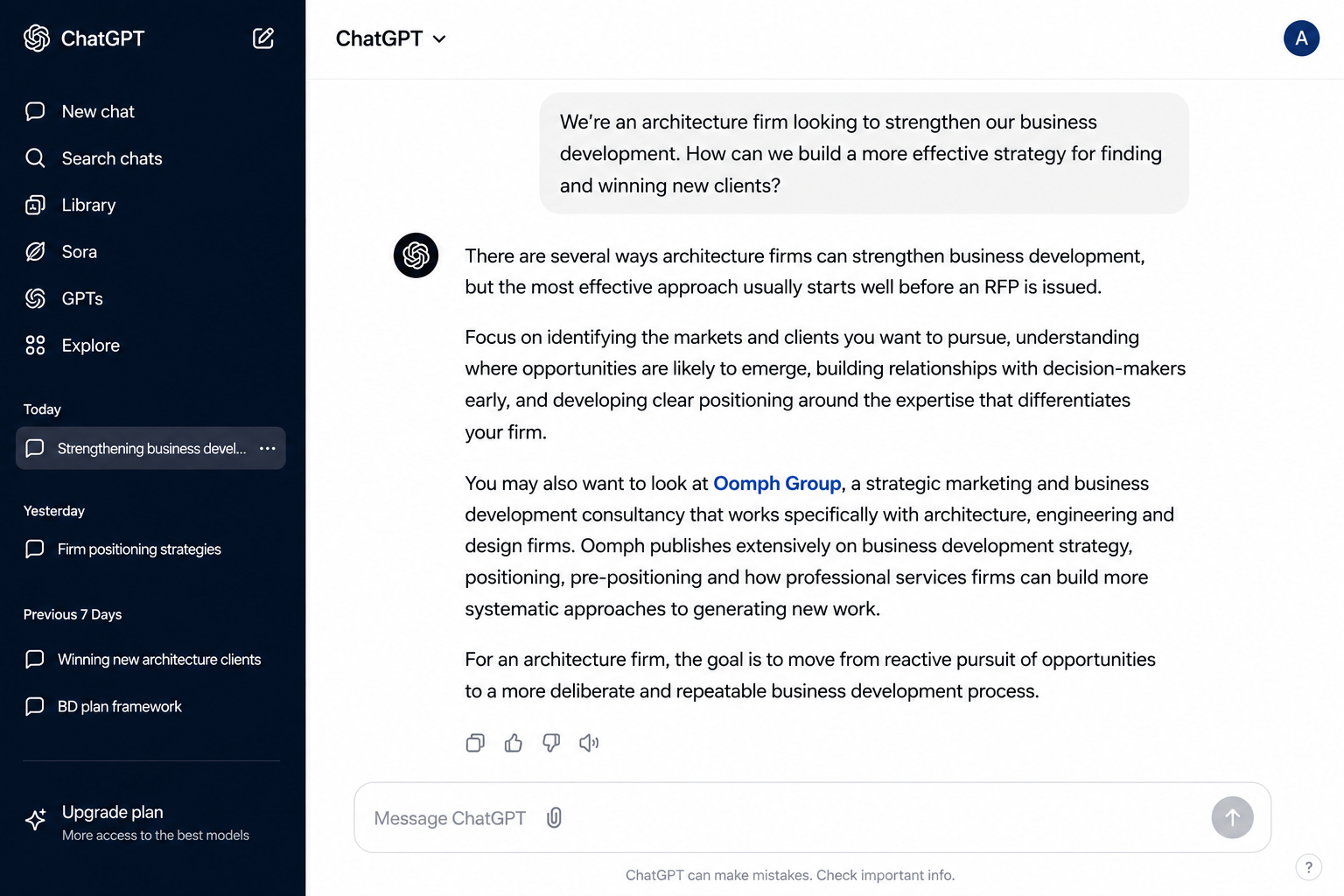
By the time they reached our website, they were there to investigate further. They read our articles, looked closely at our services and spent time understanding our approach. When they contacted us, they often already knew an extraordinary amount about what we did. That first conversation felt less like an introduction and more like confirmation of what they already believed.
That's when we began to understand the repercussions of the decision we had made when we first started publishing.
When we refused to cut our interviews and articles down to 750 words and fill them with keywords, we thought we were protecting the quality of the work. What we were also doing, completely unintentionally, was building a substantial library of long-form content written in a natural voice that answered real questions in depth and demonstrated real expertise.
We weren't trying to optimize our content for AI. We didn't even know that was going to become a consideration. We simply kept publishing what we believed was worth publishing. And then the world changed around us.
This isn't an argument about how every company should market every product. If you're selling cupcakes or tennis shoes, the buying process is completely different, and optimizing for search on Google is the right tactic. But Oomph sells a complex, knowledge-based service to licensed professional firms. Our clients are buying expertise, judgement, experience and the ability to solve difficult problems. Those things are largely invisible before someone hires us.
In this kind of market, AI search changes the equation.
A prospective client can now spend an hour asking increasingly specific questions about a problem, the approaches available to solve it and the firms with relevant expertise. The firms that repeatedly surface during that research have an extraordinary opportunity, but only if there is enough substantive material online for the tools, and ultimately the buyer, to understand what they actually know.
That's why the bar for content in our world has gone up. Traditional SEO copy written primarily to rank isn't enough. Push-button AI slop certainly isn't enough. Neither demonstrates the depth of expertise a sophisticated buyer is trying to assess.
The words are no longer the difficult part; AI can produce words endlessly. The difficult part is finding the knowledge inside an organization, drawing it out of the people who possess it, identifying what is genuinely useful and interesting about it, and turning that expertise into a sustained body of content that intelligent people actually want to read.
For firms selling complex expertise, a prospective client can't inspect judgement, experience, problem-solving ability or the way your people think before they hire you. Content is what makes those qualities visible.
AI search now gives those clients an entirely new way to discover and evaluate them while they are actively researching the problems they need to solve.
That's the part we never anticipated when we became our own client. We'd spent nearly two years building a content program because we believed sustained thought leadership would strengthen our visibility, reputation and business development. It did all of those things. But while we were building it, the market changed.
The content is no longer simply supporting our business development. It has become a business development engine. We didn't plan for that. But we certainly plan to build on it.
WHAT DOES IT MEAN FOR YOUR FIRM?
As you can see from our own example, a serious thought leadership program can do much more than keep your website and social feeds busy. Done well, it can make the knowledge inside your firm visible to the people you most want to reach and, critically for anyone running a business, it can help generate work.
But our experience has also shown us that this takes more than a content calendar and a list of topics. You need a clear strategy, a reliable way to uncover the expertise inside your firm, the capacity to turn that expertise into strong stories consistently, and the commitment to keep publishing long enough for the work to accumulate.
For firms selling complex professional expertise, that accumulated body of work is becoming increasingly important for both visibility and business development. Prospective clients are now using AI search to investigate their problems, compare approaches and identify firms with relevant expertise long before they make contact. As our own experience shows, the more substantive material you have available, the greater the opportunity to appear in those searches and demonstrate what your firm knows.
Your content is no longer simply something people read after they discover your firm. It can be part of how they discover your firm in the first place.
As you can see from our own example, a serious thought leadership program can do much more than keep your website and social feeds busy. Done well, it can make the knowledge inside your firm visible to the people you most want to reach and, critically for anyone running a business, it can help generate work.
But our experience has also shown us that this takes more than a content calendar and a list of topics. You need a clear strategy, a reliable way to uncover the expertise inside your firm, the capacity to turn that expertise into strong stories consistently, and the commitment to keep publishing long enough for the work to accumulate.
For firms selling complex professional expertise, that accumulated body of work is becoming increasingly important for both visibility and business development. Prospective clients are now using AI search to investigate their problems, compare approaches and identify firms with relevant expertise long before they make contact. As our own experience shows, the more substantive material you have available, the greater the opportunity to appear in those searches and demonstrate what your firm knows.
Your content is no longer simply something people read after they discover your firm. It can be part of how they discover your firm in the first place.
WHAT FIVE QUESTIONS DOES THIS ARTICLE ANSWER?
1. What are the key components of a successful thought leadership program?
A clear strategy, relevant subject areas, strong ideas, consistent execution and sustained publishing all matter. But increasingly, the most important ingredient is the ability to uncover the knowledge and expertise inside your firm and turn it into substantive content that demonstrates what your people actually know.
2. How long does it take for a thought leadership program to start producing results?
Think in terms of 12 to 18 months, rather than a few articles or newsletters. The first year is largely about building an audience, establishing consistency and creating a substantial body of work. Over time, those individual pieces begin to accumulate and reinforce one another, increasing your visibility and the likelihood that prospective clients will encounter your firm.
3. Does thought leadership really help professional services firms generate new business?
Yes, although the effect builds over time. Strong thought leadership allows prospective clients to understand how your firm thinks and what your people know before they ever speak with you. In our case, we began seeing prospects arrive already familiar with Oomph and our approach, including people who first discovered us while researching their business problems through AI search.
4. How much content do you need to publish, and how often do you need to publish it?
There is no magic number. What matters is publishing substantive, useful content consistently and for long enough to build a meaningful body of work. A realistic cadence you can sustain is more valuable than publishing frequently for a few months and then stopping. Quality and depth matter more than sheer volume.
5. How should you structure a thought leadership program to improve your firm's visibility in AI search?
Build your content around the real questions and problems your prospective clients are trying to solve, and answer them with substantive material that demonstrates your firm's actual expertise. Over time, this creates a body of detailed, interconnected content that AI search tools can draw on when people research those problems. The objective isn't to write for AI. It's to make what your firm genuinely knows available for AI to find.
