
Five Years Into the Upheaval: Where the Canadian AEC Industry Stands in 2026
In May and June, we’ll be looking closely at the major developments reshaping the Canadian AEC industry. The goal of the series is simple: to help firms step back, understand the larger forces reshaping the industry, and think more clearly about how to move forward in what remains a very challenging environment.

As the Canadian AEC industry closes the first quarter of 2026, we now have a much clearer sense of how the year is beginning to take shape, and we felt it was a good moment to take another broad look at where the industry stands.
Last May, we published an article examining six major shifts reshaping the Canadian AEC industry, focusing on major sector and economic trends alongside the innovation and technology changes beginning to transform the industry.
This year, however, we decided to separate those conversations and begin with a broader focus on economic conditions, which have become a much larger part of the picture over the past year. Geopolitical instability and changing economic policy in the United States are now shaping not only the Canadian economy, but also the environment in which our industry operates.
At the same time, many firms — particularly in Ontario and British Columbia — continue to weather the severe downturn in two sectors that sustained a very large portion of the industry for more than two decades: condominiums and higher education. Stalled development, shrinking institutional pipelines, and long-term market contraction continue to place many firms under significant pressure.
With all of these developments unfolding simultaneously, many of us feared that 2026 would become a recession year. What we found instead, after reviewing a wide range of economic forecasts, market analyses, policy reports, and industry data, was a more cautiously optimistic picture than we expected.
This article brings together the major trends and signals we typically encounter in fragments — interest rates, construction forecasts, policy announcements, sector updates, and regional shifts — to take a broader look at where the Canadian AEC industry actually stands right now.
The following three articles will examine the innovation side of the industry, the changing processes shaping how projects are planned, financed, delivered, and managed, and finally, the strategic question many firms are now asking: how do we adapt and position ourselves for what comes next?
WHAT WE FOUND: BROADER ECONOMIC PICTURE

It is tempting, in spring 2026, to describe the Canadian architecture, engineering, and construction industry as being in a downturn. The shorthand is convenient. It fits the headlines about stalled condo towers in Toronto, paused academic buildings on Ontario campuses, and offices that still haven’t filled back up. It matches the mood inside many firms — quieter pipelines, smaller proposal lists, harder conversations about staffing.
But “downturn” is the wrong word. Downturns end. They have a shape. You wait them out, keep your overhead lean, and eventually the work returns in something close to its old form. That isn’t what is happening here.
What the industry is living through, five years in, isn’t a recession or a market correction. It’s the slow, overlapping settling of nearly every assumption the sector built its growth model on between roughly 2000 and 2020.
COVID-19 was the shock that started the cascade — but it wasn’t the cascade itself. The shifts that followed — remote work, condo collapse, office vacancy, the contraction of higher-education capital, inflation, higher interest rates, labour shortages, distressed supply chains, tariffs, geopolitical instability, and rapid digital change — haven’t played out as a single event. They’ve unfolded, and continue to unfold, on top of one another, even as other parts of the sector have quietly stabilized or begun to grow.
CAUTIOUS OPTIMISM
Notwithstanding the upheavals of the past year, Canada is widely expected to avoid recession and ease into a soft landing. Public investment is rising. Infrastructure pipelines are real and policy-anchored. Purpose-built rental, affordable housing, retrofit, hospitality, retail, energy and utilities, defense, and regional markets outside Ontario and B.C. are all generating meaningful work. The story is uneven, not bleak.
But it is being reorganized — quietly, unevenly, in ways that are easy to miss if you read any one indicator on its own. The work is shifting. The clients are shifting. The geography of demand is shifting. The assumptions that quietly governed how firms grew — what to build a practice around, where to put offices, which sectors counted as “stable” — no longer hold the way they used to.
THE OLD GROWTH MODEL IS BREAKING

For most of the past two decades, growth in Canadian AEC was largely a question of capacity. Demand was abundant, pipelines were long, and inbound work returned if you kept your reputation and relationships in good shape. Firms grew by hiring and specialized through accumulation, adding sectors and geographies as opportunity arose.
That environment is now being fundamentally reshaped.
What is replacing it is unevenly distributed. Some firms still feel the old momentum; many don’t. The firms struggling most in 2026 are those with practices built around the safest and most predictable work. The pain is concentrated in firms that did everything right under the old approach: a strong reputation in one sector, deep relationships in one geography, inbound work shaping staffing. The risk, in hindsight, was the dependency itself.
The condominium pipeline that sustained hundreds of mid-sized practices in the GTA and Metro Vancouver is the most visible example, but it isn’t the only one. Some firms grew on a single institutional client, or on decades-long relationships with a small group of universities.
These are the traditional approaches the industry has operated under for decades. They are only now becoming risky as the broader environment shifts underneath them. What we’re watching now, sector by sector, is a series of dependency models breaking — sometimes loudly, sometimes quietly — as the conditions that made them work fall away.
The implication is that the era of growth-by-default is over. Firms can no longer assume the work will come, the sector will hold, or that the next decade will look anything like the last. Adaptability is now the principal difference between firms that move forward and firms that will continue to struggle in the years ahead.
WHERE THE INDUSTRY STANDS IN SPRING 2026
The most accurate way to describe the Canadian AEC landscape right now is uneven reorganization, with some sectors and regions under severe pressure while others continue to stabilize or grow.
Under the most pressure: condominiums, higher education, segments of office development, and tariff-sensitive scopes.
The condo story is well known, but the data still surprises people. GTA condo sales fell 15% year-over-year in Q4 2025, and average prices in many markets are off roughly 30% from the 2022 peak. Investor-driven demand has not returned.
Instead, the market is shifting toward purpose-built rental, affordable housing, and longer-term ownership models that carry very different financial, operational, and performance expectations. Many developers, consultants, and contractors now openly acknowledge that “making the numbers work” has become extraordinarily difficult. The result is not simply a slowdown, but a broader restructuring of the residential development environment itself.

The higher-education sector is facing a similarly transformative disruption. The federal cap on international student permits, paired with provincial caps in Ontario and elsewhere, removed a major revenue stream for universities and colleges almost overnight. Ontario alone is projected to lose roughly 92,000 international students in the 2025–26 academic year, a decline of 36%. Some public colleges are seeing intake reductions of up to 75%, and industry estimates suggest between $3.2 billion and $4.6 billion in education construction has already been deferred or cancelled in 2026, with Ontario accounting for more than half.
K–12 education presents a very different condition: not cyclical decline or restructuring, but sustained undersupply. Enrolment continues to expand in line with immigration and population growth, particularly in suburban and exurban regions surrounding major urban centres. The pressure is most acute in Southern Ontario, Metro Vancouver, Calgary, and parts of Atlantic Canada, where school boards are already operating at or above capacity. What limits activity is not demand, but delivery—funding approvals, land availability, and procurement timelines continue to constrain how quickly new capacity can be added. As a result, the sector is defined less by large, singular projects and more by a steady pipeline of smaller, repeatable work: standardized schools, additions, and modular expansions that function more as ongoing infrastructure than episodic development.
Healthcare remains one of the largest and most stable sources of construction activity, but it is no longer concentrated in the same way. Total health spending continues to rise, reinforcing long-term demand, yet the structure of investment is shifting. While major urban centres such as Toronto, Montreal, and Vancouver remain active, the emphasis is increasingly on distributed systems rather than flagship facilities. Governments are prioritizing regional hospitals, community-based care, long-term care capacity, and outpatient facilities as part of a broader “care closer to home” strategy. This is pushing activity into secondary and underserved markets, while large urban institutions move toward renewal, expansion, and system integration rather than major net-new builds. The result is a more fragmented but geographically broader project landscape, with a wider range of facility types and scales.
Industrial has moved out of its peak expansion phase and into stabilization. Availability has risen from historic lows and is now plateauing, while rent growth has slowed after several years of rapid escalation. Speculative construction has largely pulled back, replaced by more disciplined, pre-leased, and design-build activity. Demand has not disappeared, but it has become more selective—favouring smaller, flexible formats and well-located assets over large-scale logistics developments. In this sense, the sector is not declining but recalibrating after an exceptional cycle.
Alongside this, more strategic and policy-driven forms of development are beginning to take shape. Manufacturing, supported by supply chain resilience objectives and industrial policy, is seeing gradual reinvestment in key regions—particularly in EV, battery, and resource-linked production—though growth remains uneven and measured. Data centre development is also expanding, driven by cloud infrastructure and artificial intelligence, but constrained by power availability, land, and entitlement timelines. Both represent high-value, technically complex work, but neither operates at the volume scale of traditional commercial or residential sectors.
Office is more nuanced. Vacancy is high but appears to have peaked, with two years of modest positive net absorption concentrated almost entirely in Class A. Class B and C remain under pressure. Speculative office construction is essentially inactive. What activity exists is in retrofits, fit-outs, system upgrades, and repositioning.
Hospitality has rebounded. Retail has quietly stabilized in secondary markets and population-growth corridors outside the traditional downtown cores. Retrofit and adaptive reuse work is one of the few segments consistently growing. Energy and utilities, infrastructure, and selective industrial scopes continue to generate meaningful work, much of it tied to public investment rather than market cycles.
For many smaller and mid-sized firms, the implications go well beyond a single quiet year. Institutional work helped sustain long-term staffing, technical development, and stable client relationships across large parts of the Canadian profession. The contraction now underway represents another major restructuring of a sector that supported generations of architecture and engineering practices giving them the runway to invest in sustainability, technical innovation, and design culture itself.
Regional divergence is sharper than it has been in years. Alberta and Saskatchewan are forecast to grow at roughly 2.3 to 2.5%, while Ontario and Quebec sit closer to 0.9%. The geography of opportunity is moving, in some cases, away from the places that anchored the old growth story.
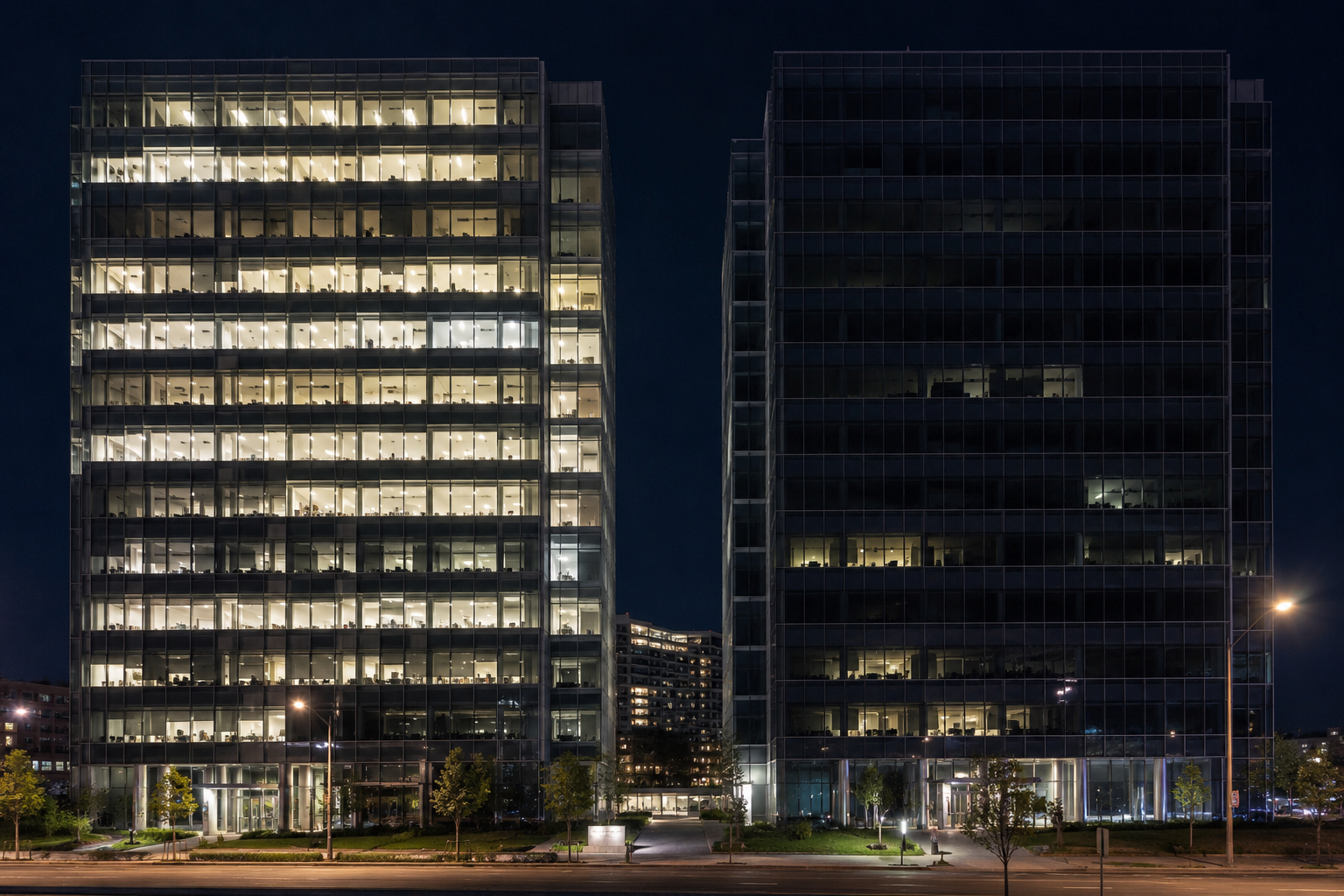
“The point isn’t that things are bad. It’s that they’re not uniform. Two firms across the street from each other, doing similar work for similar clients, can be having very different years. ”
Where adaptation is happening
What’s easy to miss, in the volume of contraction stories, is that adaptation is already underway. Not loudly, not uniformly, but visibly. Firms are repositioning. Some of that movement is recent, and some has been quietly building for two or three years. But it’s real, and it’s starting to shape what the next decade of practice will look like.
We’re not seeing single, bold moves. Instead, we see a series of small repositionings, made deliberately, that add up to a different practice. Some firms are diversifying, moving into adjacent sectors. Others are getting better at how publicly funded work is procured and delivered, which matters, as the growth ahead, in many sectors, will be policy-anchored: federal infrastructure, provincial energy programs, CMHC-backed housing, defence-related capital, and First Nations and Indigenous-led partnerships. That’s a different approach to business development that rewards firms that understand procurement, governance, long timelines, and the underwriting logic of public capital.
Some are restructuring around retrofit and renewal as a core practice. Across office, institutional, and increasingly residential, the dominant work isn’t new builds — it’s keeping existing assets viable. Firms building repeatable offerings around building envelope, systems, accessibility, conversions, and phased renewals are finding more stable backlog than firms still waiting for new construction to return.
Some are quietly expanding regionally — opening or strengthening presence in Alberta, the Prairies, or Atlantic Canada, where growth dynamics are stronger. Others are partnering with local firms in those markets rather than opening new offices outright.
What ties these moves together is a shift in posture. For two decades, firms grew by being available — answering inbound work, taking what came, scaling to meet demand. The firms adapting well in 2026 are growing by being deliberate. The cumulative effect, across enough firms, is that the next version of Canadian practice is already being built.
The industry is being reorganized

Underneath the sector shifts and regional divergence, something quieter is happening: how work gets delivered is changing.
Modular and industrialized construction is no longer a niche conversation. It’s moving, slowly but unmistakably, into the mainstream of housing, institutional, and select industrial work. Public funding programs increasingly favour it. Some clients now require it. Design for manufacturing and assembly is a different discipline than traditional detailing, with significant implications for how firms design, document, coordinate, and price their work.
Digital twins, BIM-led delivery, and AI-assisted documentation are reshaping what owners expect at the end of a project — and increasingly, throughout the project lifecycle. The gap between firms that have made deliberate investments in digital delivery and firms that haven’t is widening, and clients are starting to notice the difference.
Client expectations are changing in less visible ways too. Public-sector owners want more rigorous carbon accounting, lifecycle thinking, and post-occupancy evidence. Institutional owners — pension funds, REITs, government — want a more structured view of asset performance over time, not just at handover. Smaller private clients want faster, leaner delivery and clearer communication about cost and risk.
None of this is the technology story replacing the structural story. Technology is one layer of a much broader reorganization, not the dominant force driving it. Treating it as such, as some industry commentary does, flattens what’s actually happening.
What’s emerging is not a single new model for practice, but a more fragmented, performance-driven, and operationally complex industry than the one many firms built themselves around over the past two decades. The firms adapting successfully are not simply waiting for conditions to improve; they are repositioning themselves for a different market altogether.
Adaptability is becoming the competitive advantage

The Canadian AEC industry isn’t going to return to the operating model of 2010 or 2018. The conditions that made that era feel stable — abundant condo demand, predictable institutional pipelines, low interest rates, growing international enrolment — were always less permanent than they looked.
What is emerging instead is a more varied and less predictable practice environment. Public investment is rising. Infrastructure spending is real and policy-anchored, not cyclical. Retrofit and renewal are becoming foundational practices. Modular and industrialized delivery are changing the economics of certain sectors. Regional growth is shifting outward. New funding frameworks, new client expectations, and new delivery models are creating openings that didn’t exist five years ago.
The firms that will do well in this period will be the ones that focus on their strengths and develop a clear plan for the kind of firm and practice they want to be in 2030, then make deliberate decisions to get there. Thoughtful expertise, sustainability capabilities, design culture, technical depth, and long-term client relationships are not being thrown away. They are being put to work in different conditions. The firms that struggle most will be the ones still waiting for the old conditions to come back.
Adaptability, in this context, is not a soft skill. It is the practical difference between the firms that will continue to thrive and those that will fall behind. The work is there. The clients are there. The next decade of Canadian practice is taking shape now, and the decisions firms make this year will be pivotal. The question is whether firms read this reorganization as a temporary disruption, or as the actual shape of what comes next.
Sources References
AcademicJobs.com – Higher Education Capital Impact Reporting
Altus Group – Canadian Office Market Update
Altus Group – Canadian Industrial Market Update
Altus Group – 2026 Canadian Cost Guide
Auditor General of Canada – Impact of International Student Permit Cap
Bank of Canada – Monetary Policy Decision Recap: Vigilant but Patient
BuildForce Canada – Construction & Maintenance Looking Forward
Canadian Construction Association – Construction Industry Navigates Higher Costs and Geopolitical Volatility
Canadian Press – Construction Sectors Face Tariff and Labour Challenges
CBC News / Radio-Canada – Ontario International Student Losses
CBRE – 2026 Canada Real Estate Market Outlook
CBRE Canada – Office Market Statistics
CMHC – Housing Market Outlook, Spring 2026
Deeded.ca – GTA Condo Prices: February 2022 vs February 2026
Government of Canada – Federal Budget 2026 / Build Communities Strong Fund / Build Canada Homes
HUB International – Construction Outlook 2026
ICEF Monitor – Impact of Canada Student Cap Far Greater Than Expected
Maclean’s – International Student Caps Are Decimating Canadian Colleges
RBC Economics – Quarterly Canadian Outlook: Growth Headwinds Offset by Stabilizing Trade and Jobs
RBC Economics – One Year of Tariff Shocks in Canada: What We Learned
RBC Economics – Mixed Start to Canada’s Housing Market’s Busiest Season
RBC Economics – Population Downturn & Rising Supply to Keep Apartment Rents in Check
RBC Economics – Canadian Labour Market Steadied in March
RBC Wealth Management – Canada’s 2026 Economic & Market Outlook
RLB – Canada Construction Cost Report, Q1 2026
Statistics Canada – Building Construction Price Index
Statistics Canada – International Student Enrolment Estimates
TRREB – Condo Market Report, Q4 2025
Turner & Townsend Canada – Construction Market Outlook, Q1 2026
