
How Professional Value Becomes Work: The Business Development Continuum

For many architecture, engineering, and construction firms, business development is still understood as a moment rather than a system.
It is associated with proposals, interviews, and pursuits — the visible, high-pressure points where firms are asked to compete for work that has already been defined. These moments matter. But they sit at the very end of a much longer process, and when firms engage only at this stage, they are operating at a structural disadvantage.
What precedes a proposal is not silence. It is months or years of planning, budgeting, relationship-building, internal debate, and incremental decision-making on the client side. By the time an opportunity becomes visible, expectations have already formed. Constraints are already in place. And informal assessments of credibility often exist, whether firms are aware of them or not.
This is why selling in professional services cannot be understood as an event. It is a continuum — a sequence of professional actions that gradually reduce uncertainty and make expertise legible over time. When firms treat business development as a system rather than a scramble, it becomes quieter, steadier, and more aligned with professional practice.
Focus and Selectivity: Where Selling Actually Begins
Most firms do not struggle with selling because they lack talent or effort. They struggle because they are unclear about where they are trying to be relevant — especially now.
In stable markets, focus often emerged organically. Firms grew within familiar sectors, geographies, and client networks. Reputation did much of the work. Today, many of those legacy markets are underperforming, forcing firms to look elsewhere for opportunity.
The risk in this moment is not a lack of ambition. It is reactive overreach.
When firms attempt to reposition across too many sectors or markets at once, selling effort scatters. Messaging dilutes. Relationships remain shallow. Capability may exist, but credibility does not — and in unfamiliar contexts, that distinction matters more than ever.
Focus, in this environment, is professional discipline under pressure. It is the act of deciding where a firm’s expertise can realistically be understood, trusted, and built upon — given time, resources, and existing strengths. Without this selectivity, business development becomes indiscriminate chasing rather than intentional engagement.
Choosing where to invest professional attention is the first, and often most difficult, selling decision a firm makes.
Market Intelligence and Listening: Selling Before You Speak
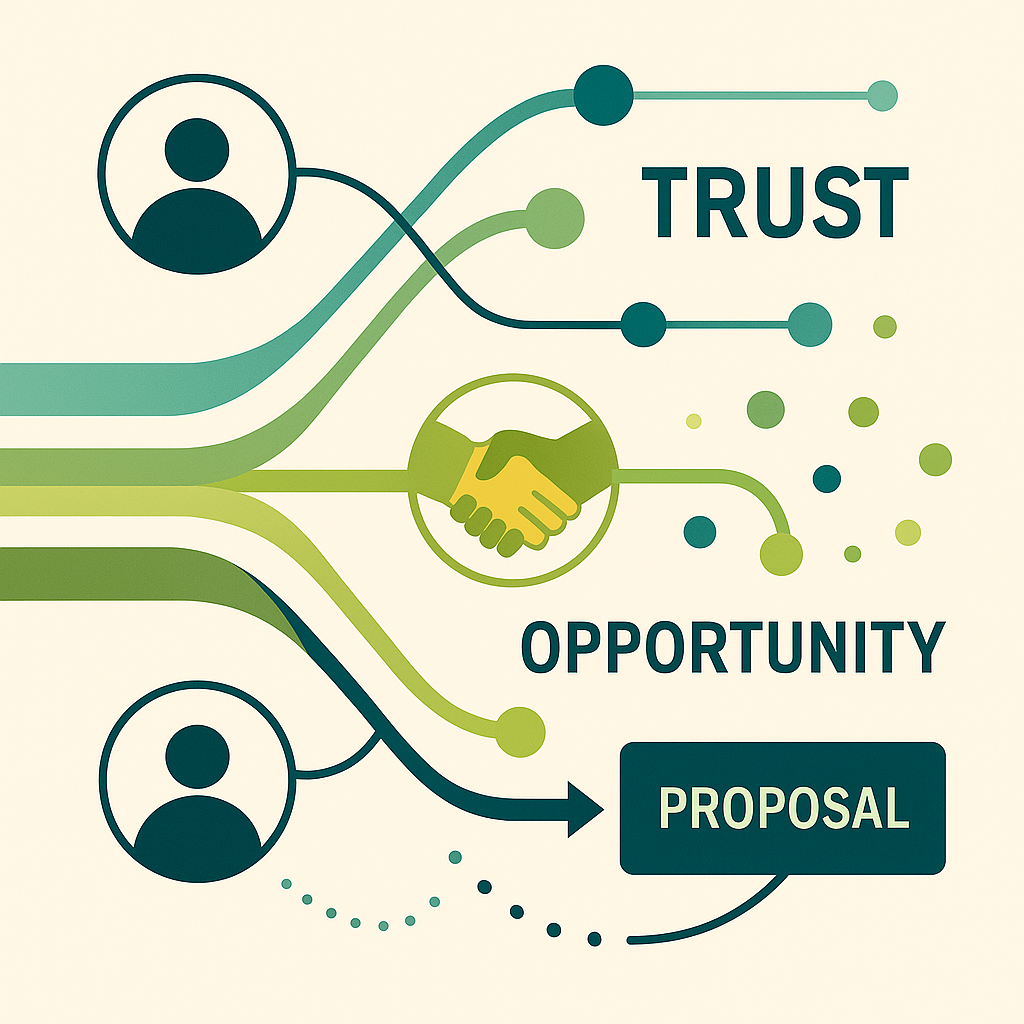
One of the most persistent misconceptions about selling is that it begins with talking.
In reality, the most effective business development work happens before outreach begins. It starts with listening — to markets, to clients, and to the conditions shaping demand.
Firms often default to describing what they do rather than understanding what clients are navigating. But relevance is not created through explanation alone. It is created through alignment — between professional expertise and the pressures, risks, and decisions clients are actually facing.
Listening sharpens both timing and tone. It allows firms to recognize early signals: shifts in funding, changes in policy, emerging delivery models, or evolving expectations that will eventually translate into projects. Without this awareness, even well-intentioned outreach can feel generic or mistimed.
Seen this way, selling is not persuasion. It is professional curiosity and pattern recognition applied consistently over time. Firms that listen well rarely sound louder — they sound more relevant.
Relationship-Building Before Opportunity: Trust Without a Project
In many firms, relationships are treated as something that follow work rather than precede it. This assumption made sense when pipelines were stable and networks were inherited. It is far less reliable now.
In new markets or sectors, waiting for a project to exist before engaging often means arriving too late. By that point, clients are no longer seeking perspective — they are seeking compliance.
Relationship-building in this context is not networking for its own sake. It is professional engagement without immediate payoff. It involves showing up in conversations where no opportunity is yet defined, contributing insight without expectation, and maintaining continuity between projects.
This work can feel uncomfortable precisely because it does not produce immediate results. But it is what allows firms to be seen as thoughtful, credible participants rather than transactional responders when opportunities eventually emerge.
Trust does not begin at procurement. It begins much earlier, through consistency, relevance, and presence.
Presence and Consistency: How Credibility Compounds
Credibility is rarely established in a single interaction. It is built through repeated, coherent signals over time.
Many firms operate in cycles: intense visibility during pursuits, followed by long periods of silence once work is secured. This on-and-off approach makes it difficult for trust to compound, particularly in unfamiliar markets.
Presence does not require constant activity. It requires coherence. Being known for something specific, showing up consistently in the same conversations, and maintaining continuity between projects all contribute to a sense of reliability.
This is where many business development efforts quietly fail — not because they are ineffective, but because they are intermittent. Firms that sustain presence, even when no immediate opportunity exists, are far better positioned when demand reappears.
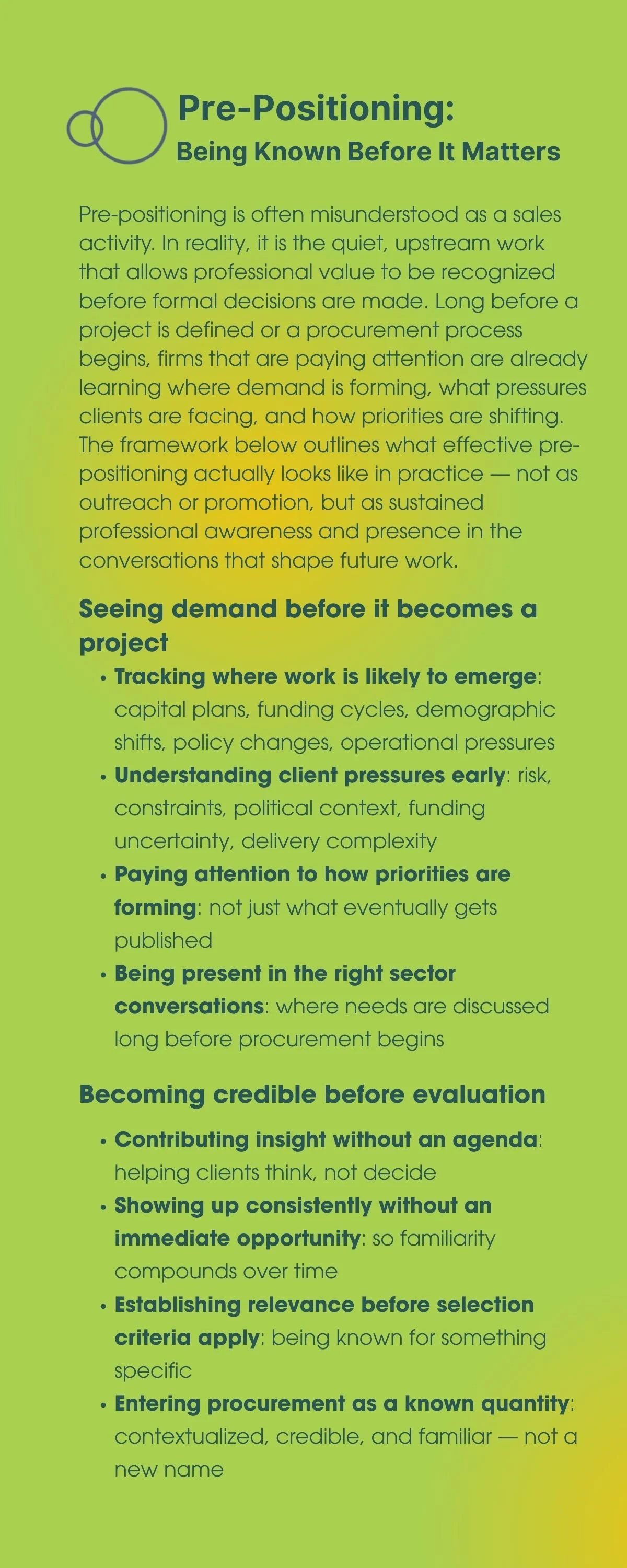
Opportunity Shaping and Pre-Positioning: Selling Before the RFP Exists
By the time an opportunity is formalized, much of what matters has already been decided.
Scope, expectations, delivery approach, and success criteria often form long before a project is publicly visible. Firms that engage only at the formal stage are responding to decisions rather than helping shape them.
This is where pre-positioning becomes critical — and where it is most often misunderstood.
Pre-positioning is not about influence or advantage. It is about familiarity and credibility before evaluation begins. It ensures that when an opportunity crystallizes, a firm is already understood rather than newly introduced.
This applies in both private and public work, though the mechanics differ.
In the public sector especially, firms often assume that strict procurement rules eliminate the possibility of early engagement. In reality, those rules govern selection — not awareness. Public agencies routinely engage industry to understand challenges, capabilities, and emerging approaches long before procurement begins. Firms that participate in these conversations are not guaranteed work, but they are rarely unknown when opportunities formally emerge.
Pre-positioning, at its core, is early professional engagement. It is the work of being useful, present, and relevant before there is anything to win.
Who Carries the Work at Different Moments
One of the most common sources of friction in business development is the assumption that contribution should look the same across a firm. It shouldn’t — and it doesn’t.
In practice, business development works when responsibility is distributed according to where value is created at different moments, not according to job titles alone.
Some work is about sense-making: understanding markets, clarifying priorities, and articulating what the firm stands for. Some work is about continuity: maintaining momentum, tracking conversations, and ensuring effort compounds rather than resets. Some work is about judgment: helping clients assess risk, fit, and long-term implications when decisions are being formed.
Marketing tends to anchor the first of these — creating coherence, clarity, and a shared external narrative. Business development functions tend to anchor the second — sustaining relationships, maintaining focus, and connecting activity back to strategy over time. Leadership and senior practitioners anchor the third — bringing experience, credibility, and perspective at the moments where confidence matters most.
Technical leaders and project teams often operate across all three, particularly through long-standing client relationships that extend beyond any single pursuit. Their day-to-day interactions frequently shape how a firm is perceived far more than formal selling activity ever could.
When these contributions are understood and coordinated, business development stops feeling like an added burden. It becomes part of how the firm operates — quieter, more deliberate, and far more effective.
Why the Continuum Matters

When business development is treated as a series of disconnected activities, effort fragments and results suffer. When it is understood as a continuum, each action reinforces the next.
Firms that invest only at the proposal stage compete at the weakest possible moment. Firms that engage earlier — through focus, listening, relationships, presence, and pre-positioning — build credibility long before it is tested.
In the months ahead, we’ll explore two of the most visible elements of this system — proposals and websites — and why they fail when the upstream work hasn’t been done. But those tools are only effective when they sit within a broader, intentional continuum.
Selling in professional services is not about persuasion. It is about making value legible, trusted, and timely — so that expertise has a chance to become work at all.
