
The Proposal Setup Nobody Talks About — But Everyone Should
There is a phase of proposal work that rarely makes it into industry articles or conference presentations. We talk about differentiators, win themes, executive summaries, and storytelling — all of which matter. But very little attention is paid to the setup phase: the disciplined groundwork that determines whether a submission is compliant, complete, and defensible before a single paragraph of narrative is written.
In my experience, most proposal failures are not caused by weak messaging. They are caused by preventable mistakes. A missed sub-clause. A required form buried deep in an appendix. A paragraph in section 3.1.1.2 that no one noticed because the team never fully mapped the RFP structure before drafting began.
I have seen proposals disqualified over omissions that amounted to less than half a page of content. In one case, an 800-page submission was rejected because two short paragraphs were missing. The technical response was strong. The team was capable. The effort was enormous. It did not matter.
In AEC, if you miss a requirement, you are out.
This article is about the unglamorous part that prevents that outcome: the proposal setup discipline that reduces internal chaos, protects against disqualification, and creates the conditions for strong writing and presentation — including how to use AI without losing your reputation.
Your Insurance Against Disqualification
Every disciplined proposal process should begin with a complete outline that mirrors the RFP exactly — section by section, number by number, heading by heading. Two reasons teams often skip this step.
First, many teams simply aren’t used to working this way. They open the RFP and start drafting immediately, building the response as they go rather than mapping the full structure and requirements up front.
Second, even when teams know an outline is best practice, it can feel like extra makework under deadline pressure — another time-consuming step before anyone gets to “real writing.” So they move straight into drafting and hope they can manage the structure along the way.
Both are understandable. Both are risky.
How to Set Up the Outline
The outline can be built as a simple table in Word or an Excel spreadsheet. Both work. The choice depends on team familiarity and proposal complexity.
Before you get into section-by-section requirements, set up the top of the outline with the submission facts that can derail you late in the process. These details are often buried in administrative pages — and they matter as much as the response content.
At minimum, capture:
Submission deadline (date, time, and time zone)
Submission method (portal upload — including URL, email, courier, hard copy)
File format requirements (PDF, Word, separate schedules, separate forms)
Submission packaging instructions (e.g., technical proposal in one sealed envelope and fee proposal in a separate sealed envelope; separate digital uploads for financials)
Naming conventions (file names, project numbers, versioning rules)
Page limits (and what counts — excluding covers? excluding resumes?)
Required forms and declarations (and whether they must be separate files)
Signature requirements (wet signature, digital, authorized signer)
Delivery details (address, department, person, building access rules)
Clarification process (deadline to submit questions, contact protocol)
Why be this explicit?
Because proposals routinely run to the last hour — sometimes the last minute. Panic happens when nobody is certain whether the deadline is local time or portal time, whether a declaration must be submitted separately, whether financials go in a different envelope, or whether hard copy delivery is required and who is physically taking it there.
Capturing these details at the outset removes that uncertainty.
Once that “header” information is documented, build the body of the outline so every RFP section is tracked clearly. For each numbered section, your outline should include:
RFP section number and title (exact)
Requirement summary (what is actually being asked)
Mandatory or rated (as applicable)
Evaluation criterion reference (if provided)
Accountable lead
Contributor(s)
First-draft deadline
Review deadline
Final proof deadline
Status (not started / drafting / in review / complete)
Links to source files (SharePoint/Teams folders, resumes, case studies, forms)
Notes / risks / clarifications
Word tables can work well for smaller proposals and straightforward tracking. Excel can be helpful when you need more visible columns for deadlines, links, status, and notes without the table becoming unreadable.
The tool is secondary. The structure is what protects you.
The Non-Negotiable: Mirror the RFP Exactly
Once you have an outline format in place, one rule becomes non-negotiable: The outline must mirror the RFP exactly.
In public procurement, requirements are often binary. Evaluators are scoring against a checklist. They are not interpreting intent or reorganizing your submission in their heads. If the requirement is not located under the numbered section they are reviewing, it may be scored as “not provided.”
Small omissions are not small in procurement. A required statement placed in an appendix instead of where requested can be treated as non-compliant. A form embedded in the main PDF instead of submitted separately can trigger rejection. A response that blends multiple required sections into one narrative may be marked incomplete because the evaluator cannot tie it cleanly to a specific criterion.
This is why the outline matters. It’s a risk-control tool — your safeguard against omitting a subclause that could cost you the submission, especially when you’re racing a deadline or trying to avoid another late night at the office.
And there’s a second non-negotiable embedded inside the first: Do not impose a second numbering system.
If the RFP uses 3.2.4, your outline uses 3.2.4. Period.
Do not create an internal 1–9 sequence on top of a document that already has 3.1.1.2, 3.1.1.3, etc. That “extra clarity” becomes confusion the minute multiple contributors are working. People start referring to different systems, and the team loses time translating labels instead of producing accurate content.
The simplest rule is also the safest: the RFP numbering is the single source of truth.
Proposals in the Age of AI
In the last few years, proposal teams have gained a new tool that can be genuinely useful at the front end of proposal work — especially when an RFP is long. Used properly, it can save hours and support faster go/no-go decisions when a document is 150–200 pages and someone would otherwise burn a full day just determining whether the opportunity is feasible.
The first and most valuable use is first-pass screening for go/no-go.
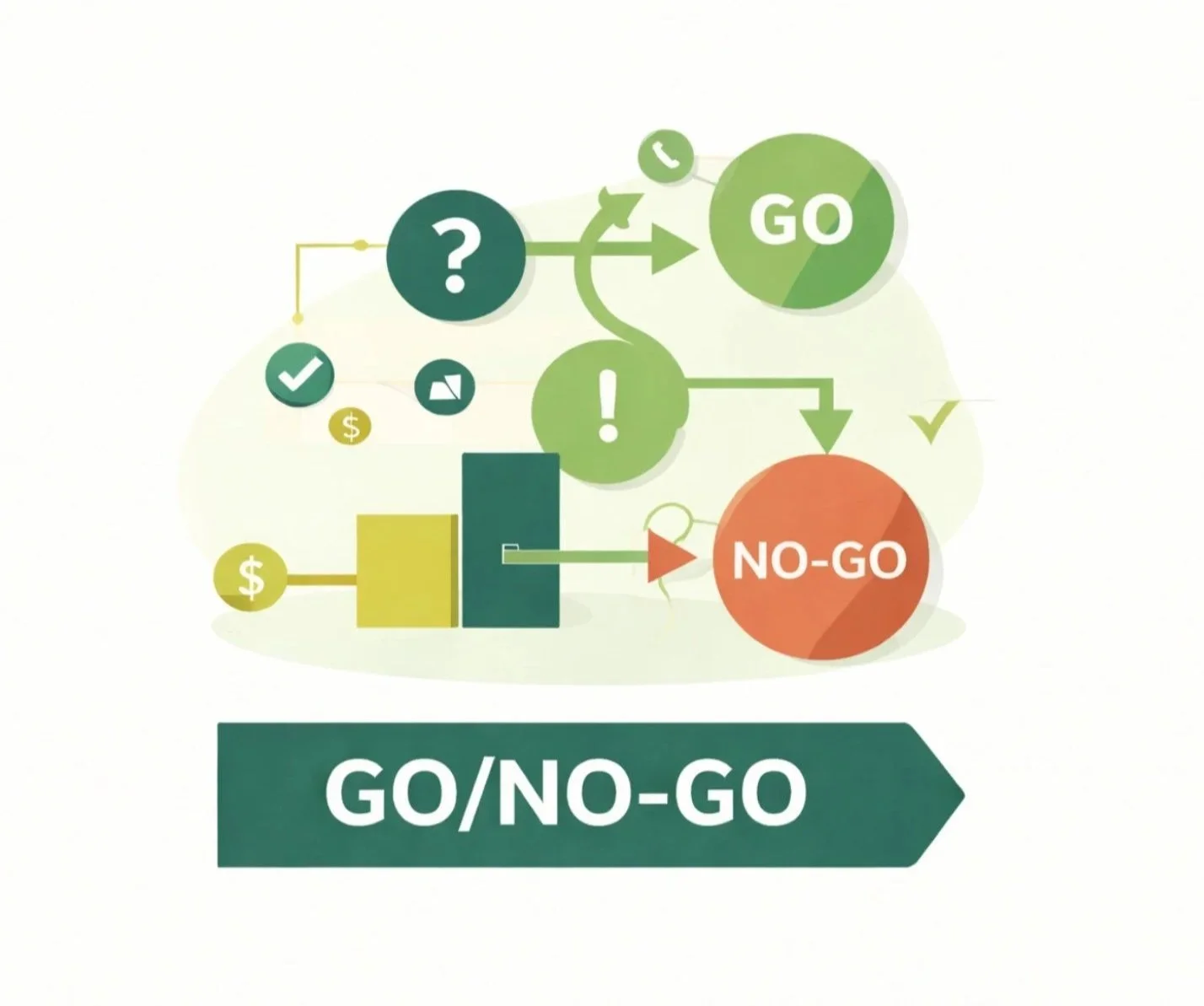
Today, you can upload an RFP PDF into ChatGPT, Copilot, or a similar tool and prompt it to produce a structured summary. Within minutes, it can pull out the information a team needs to decide whether the pursuit is worth the effort, including:
What the project is (scope, context, and what the client is actually procuring)
Can we win this? (experience requirements, required portfolio examples, and time windows such as “completed within the last five years”)
Constraints and risk flags (unusual conditions, approvals, phasing, insurance, schedule constraints, delivery requirements)
How it will be evaluated (criteria and weighting, if provided)
If the decision is “go,” AI can help in a second, more operational way: generating the outline.
Instead of manually transcribing headings and numbering into a table, you can prompt the tool to extract the RFP structure — section by section, number by number, heading by heading — so you have a clean starting point for your outline or compliance tracker. From there, the team can add what drives execution: accountable leads, deadlines, status, and notes. The value is simple: it reduces setup effort and makes it far easier to build the outline instead of skipping it.
A third practical use is editing and compression.
AI is effective at tightening language, improving clarity, correcting grammar, and reducing text to a defined word count when page limits are strict. Used this way, it functions as an editorial assistant — not a proposal author.
What AI should not be used for
Beyond these uses, caution is warranted. Proposals operate in a risk-managed environment. They are formal submissions that can carry contractual and reputational consequences. AI should not be used to draft substantive proposal content from scratch. It is a tool for extraction, structure, and editing — not a substitute for professional judgment.
The Hidden-Layer PDF Disaster
One AI risk is not obvious until it happens: PDFs can contain hidden layers or embedded content that humans do not see in normal viewing but software can still extract.
RFPs are often adapted from older templates. During drafting and reformatting, legacy text can remain in layers, comments, or embedded structures. Humans skimming the visible pages never see it. But an AI tool processing the file can pull it — and treat it as real requirements or scope.
That is how you end up with an AI-generated summary that refers to the wrong project parameters — and if a team is rushing and doesn’t catch it, that wrong scope can make its way into the response.
The consequences are serious: disqualification, client distrust, reputational damage, and in some cases formal complaints about recycled or careless content.
The safeguards are practical:
Use the cleanest official RFP copy available (not marked-up drafts).
If possible, flatten the PDF before processing (remove layers/markup).
Treat AI summaries as hypotheses that must be verified against the visible RFP.
When AI output surprises you, investigate the source — don’t ignore it.
Build a final compliance review step that checks the proposal against the RFP directly, not against an AI-generated summary.
AI saves time. It also increases the importance of final human controls.
Another Pressure Point — and Another New Tool
Beyond structure, compliance, and AI-assisted setup, there is another major challenge in proposal work: assembling the content itself.
Proposals require pulling together large volumes of material — case studies, biographies (CVs), project sheets, sector variations, standard language, iterations, declarations, and forms — all tailored to the specific opportunity. Much of it must be continuously updated, reformatted, or customized. In larger pursuits, biography sections alone can run hundreds of pages. Contributors may be spread across multiple offices or even multiple countries. The scale of coordination is significant.
As proposal volume increases, so does the effort required to locate, confirm, and assemble current material accurately and consistently.
In response to this pressure, a newer generation of cloud-based proposal platforms has emerged. These systems are designed to centralize proposal content, maintain version control, structure compliance requirements, and make retrieval faster and more reliable — particularly for firms with steady pursuit activity and distributed teams.
What Modern Proposal Platforms Now Offer
Modern cloud-based proposal platforms are evolving beyond simple content libraries. A newer generation of tools, such as Seev — an AI-driven system designed specifically for AEC firms — combines opportunity tracking, compliance structuring, content search, and drafting support in one environment.
At the front end of the pursuit cycle, these systems can monitor public RFP boards globally and surface opportunities that align with a firm’s defined criteria. Instead of manually scanning procurement portals, teams receive curated recommendations based on sector focus, geography, services, and project type. For larger firms, this function is often handled by dedicated business development staff. For smaller and mid-sized firms, automated monitoring can meaningfully reduce time spent searching for leads.
Once an opportunity is identified, platforms like Seev can parse complex RFP documents and generate structured summaries, highlight key requirements, and build a compliance matrix that mirrors the RFP numbering. That matrix becomes the working outline — extracting mandatory items, page limits, submission instructions, and evaluation criteria into a format that proposal teams can act on immediately. Some systems also perform compliance checks against draft submissions, flagging gaps before final upload.
On the content side, these platforms index resumes, project sheets, boilerplate sections, and institutional knowledge, making them searchable inside daily tools such as Teams or SharePoint. Rather than rebuilding content manually, proposal teams can retrieve validated material quickly and assemble responses within a structured drafting interface. Most systems export back into Word for final formatting and submission.
These tools represent a meaningful investment. They are most effective for firms with steady proposal volume and distributed teams. For firms pursuing fewer opportunities each year, many of the same controls — mirrored outlines, compliance matrices, centralized content, and disciplined review — can be implemented manually with Word, Excel, and structured file management. The principle is identical. The difference is automation and scale.
Closing
Proposal work will always be intense. Deadlines will always compress. Subject matter experts will always be busy.
But today, we have better processes and better tools to make what has always been an incredibly time-consuming, complex, and expensive undertaking more manageable.
Disciplined setup. Mirrored outlines. Clear compliance tracking. Thoughtful use of AI for screening and structure. And, where appropriate, cloud-based systems that organize and surface the right content at the right time.
None of these eliminate the effort. Proposals will never be effortless. But they do make the work more controlled, more predictable, and far less vulnerable to preventable mistakes.
Whether implemented manually or through platforms, the options now exist at every scale — for five-person firms and for global practices — to bring clarity to what was once largely reactive.
And in a procurement-driven environment, clarity is not a luxury. It is a competitive advantage.
