
How AEC Leaders Can Navigate the Biggest Disruption in a Generation(Thoughts from my recent conversation with Design Tennis)
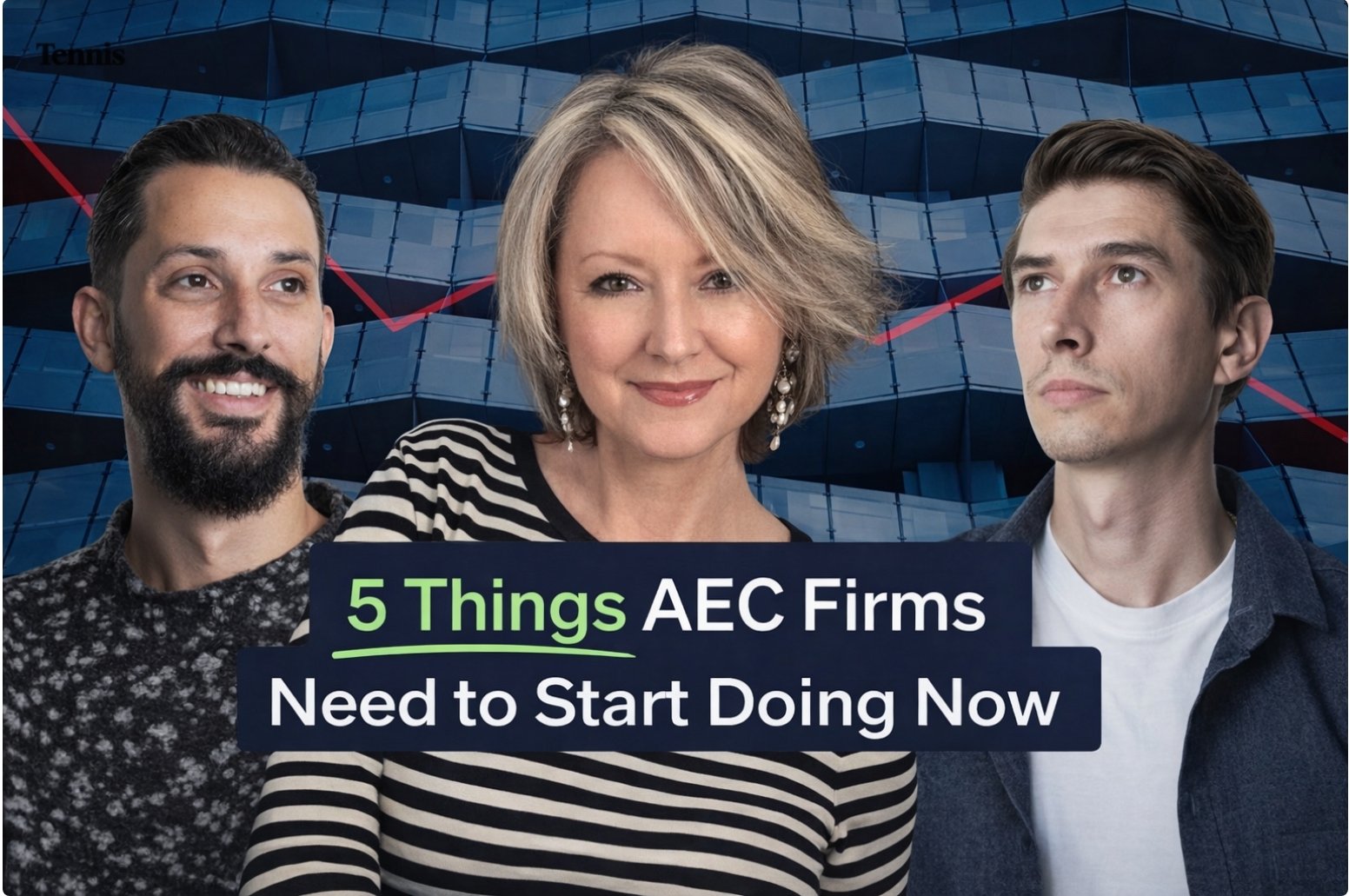
I recently had the pleasure of joining Marcello Gortana and Symon Oliver from Design Tennis for a wide-ranging conversation about what’s actually happening inside architecture, engineering, and construction right now — and what leaders can do to respond with clarity instead of caution.
Marcello and Symon work closely with AEC firms on digital strategy and websites, so the discussion naturally connected market disruption to a topic many firms still underestimate: your website as a business development tool — not just a portfolio.
If you’re leading a firm into 2026, I hope this recap helps you separate noise from signal — and focus your next moves.
Watch the full interview here: https://www.youtube.com/watch?v=47FsfmLpRX8
The “perfect storm” AEC hasn’t seen before
One of the biggest points I made in the interview is that we’re seeing an unprecedented convergence of pressures — not a typical down cycle that “returns to normal” in a year or two.
From what we’re hearing on the ground (including directly from developer conversations), large parts of the market are stalled — and some expect the condo market to take years to truly recover.
What makes this moment different is the combination of: market shocks (multiple sectors slowing at once), plus digital disruption changing how buildings get delivered and who captures value. That’s why this feels so disorienting for many firms — and why “just wait it out” is a risky strategy.
“I’ve never seen three sectors go out at the same time — the office market, the condo market, and the education market — on top of digital disruption.”
Digital disruption isn’t just BIM
When people hear “digital transformation” in AEC, they often think of design tools. But the disruption is broader than that.
In the episode, we discussed how the biggest shifts are increasingly visible on the construction and delivery side — including:
digitized construction/project management systems
automation and robotics in parts of the build process
drones, imaging, and scanning workflows
modularization and prefabrication of major building components
and now AI as an accelerant across the whole chain
The takeaway: there will still be design and building — but the process, players, and expectations are changing quickly.
Consolidation has changed the competitive field
Another major change: the sector has shifted from a landscape dominated by professional services firms to one where publicly traded corporations and conglomerates play a larger role — and compete aggressively across markets.
That has a downstream effect on midsize and smaller firms: you’re no longer only competing against “similar” firms. You’re often competing against organizations with entirely different infrastructure, systems, and marketing maturity.
Which brings us to the part of the conversation Marcello and Symon see every day…
The website shift: from portfolio to sales tool
AEC has historically been powered by referrals and long-running relationships — the “usual suspects” teams that show up together for years.
But when that system loosens (or stops), firms need to reach beyond their traditional networks. And in that environment, your website becomes more than a gallery.
At minimum, we discussed three foundational upgrades many firms can tackle even before a full rebuild:
1) Case studies, not just images
Photos are not a story. A strong case study helps a prospective client understand:
the problem or constraint
the approach
the outcome
what your team uniquely contributed
2) People, clearly presented
AEC is professional services. Clients are buying expertise and judgment — they need to see who they’ll work with.
3) Practical health checks
Symon raised an important point about accessibility compliance and baseline performance checks. Even basic audits can prevent painful, expensive surprises later.
The hard truth — and the encouragement
We ended the conversation with a question I wish more leaders were asking:
Hard truth: this is not simply a temporary downturn that resets back to the prior model.
Encouragement: in every era of disruption, the firms that see clearly and move deliberately are the ones that find opportunity — and come out stronger.
The firms that will lead the next cycle will be the ones that combine:
focus (clear positioning and target markets)
a realistic plan (marketing + BD together)
and the willingness to modernize how they show value in the marketplace
“This is not a temporary situation. But every period of disruption creates opportunity for firms that see clearly and act deliberately.”
Want to go deeper?
If this conversation resonates, you’ll find more practical tools and planning resources in our News section at Oomph Group — including our recent work on building strategy and planning systems for AEC leaders.
And a sincere thank you again to Marcello and Symon at Design Tennis for having me on — I’d love to continue the dialogue, especially on what it really takes to turn an AEC website into an effective sales engine.
Watch the full interview: https://www.youtube.com/watch?v=47FsfmLpRX8
